
Treydan Stukes, the hot “Rams beater” prospect a lot of fans would like to see the Seahawks draft this week, was born on Sept. 11, 2001 (yes, 9/11). That means he will turn 25 two days after the Seahawks open the 2026 NFL season.
Stukes, who was called “Unc” by younger Arizona teammates, is one of the poster children for the trend of aging NFL draft classes.
As John Schneider cracked, “We have some guys who have been in school for six years. They’re called doctors.”
An apropos joke considering this overall aging of rookies is partly a product of Covid.
Schneider seems to think the trend will reverse. “It’s my understanding this should be the last year of it,” he said this week.
But other NFL execs think the aging of rookie classes will continue as long as NIL rules college football.
Underclassmen are staying in school, looking to make more NIL money while hopefully boosting their draft stock. And many players are seeking to get around the “four seasons in five years” eligibility rule, as Andrew Brandt told Seattle Sports Radio this week.
“There is a changing dynamic we’ve seen with the draft. Players are older,” Baltimore GM Eric DeCosta said. “We’re seeing more 24- and 25-year-old players. That’s because of Covid initially, and now because of NIL guys getting paid to stay in.”
Per The Athletic, drafts now have half as many underclassmen as they had back in 2021.
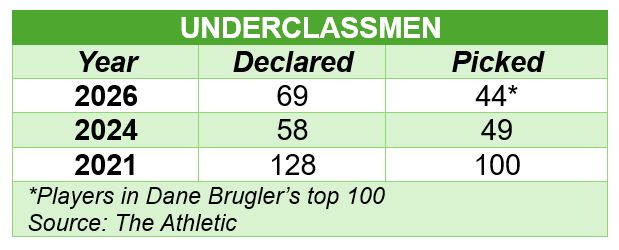
“It’s something we’ve seen over the last three years,” DeCosta said. “This will be the third year — 2024, 2025 and 2026. We might have had 4% of our players on the draft board (age) 24 1/2 or older prior to 2024; now that number is up to 18%. So we’ve seen a 14% increase in older players on the draft board.”
Chiefs GM Brett Veach said his team had to remove over 25 players from their top 75-100 this year when the official underclassman list came out and a bunch of guys had chosen to stay in school.
“So it really impacts, I think, the draft, and then you’re getting older, older prospects as you go on,” he said, via PFT. “I don’t think that’s going to change any time soon, and I think that’s something we have to adapt to.”
This trend has not only made rookie classes older; it has watered down the draft, according to some execs.
“Some that put their names in for an evaluation, let’s say they come back as a fourth- to sixth-round pick,” Houston GM Nick Caserio told The Athletic. “If they have the opportunity to maybe receive that same amount in (NIL money), maybe they feel the best thing for them is to go back and to play more (college) football.”
That has diluted Day 3, in particular. Schneider said the Seahawks saw the lack of depth in this draft last fall, which is why they were comfortable giving up their 4 and 5 for Rashid Shaheed.
John Lynch, GM of the 49ers, said the NFL always has viewed college “as somewhat of a feeder system. Now it’s almost like we’re in competition, and you’re seeing a lot more 25-year-old rookies. That’s probably the biggest change. Covid had something to do with it, but it’s also the opportunity for these guys to stay and make good money doing what they’re doing. I don’t have all the answers there, but I do believe it’s something as a league we have to pay a lot of attention to.”
Veach and DeCosta are among those who do not like it.
“That’s problematic for us because if guys are coming in older they’ve probably got less upside,” DeCosta said. “They’re not three-contract players in some cases; they’re two-contract players. And in some cases they’ve got more injuries. They’ve been playing college football longer, so they’ve taken on more injuries.”
Stukes is a case study for that. He walked on at Arizona in 2020, redshirting. He played three seasons, then suffered a torn ACL in 2024 that cost him the final eight games (he received a medical redshirt) and the first two of 2025. So six years, including two redshirt seasons.
Veach also is among those who think the upside on Day 2 guys is not as good as it used to be.
“Typically, the second and third round would be those guys that maybe they didn’t play a lot, but they were young,” Veach said. “Well, now these guys are just bouncing (via the transfer portal) and getting paid by another school. … So Round 2, 3, 4 … you’re getting a more finished product. So that’s challenging, but that’s what we have to adapt to in how we position our board.”
“We’re trying to get a handle on that,” DeCosta said. “It’s tough for us to assess what that means. … I don’t think it’s a good thing, certainly. Historically we’ve tried to draft younger players when we can. That’s something we feel strongly. But now we’ve got 18% of the draft board that’s over 24 years old. So that’s going to change the way we target players.”
So both Kansas City and Baltimore are in the group of teams that seem like they are demoting older players.
Carolina GM Dan Morgan, a former Schneider lieutenant in Seattle, is among those who do not seem as concerned.
He echoed what Schneider and other coaches and GMs have said about NIL being a good way for teams to learn more about players before they get to the NFL.
“I think NIL is actually somewhat of a good thing, because it gives us a little bit of a snapshot of what he’s like with money,” Morgan said. “From my perspective, it’s good to kind of see: What did he do with this money? Did he spend it recklessly? Did he go out and get in trouble with it? It tells you a lot about somebody.”
Morgan wishes some players would come out early, but, “We just gotta evaluate who is at our disposal.”
Caserio seems to have the same approach: “A lot of those players are choosing to stay, and that’s OK. We can evaluate who’s available, and then we’ve probably evaluated the player going back to school maybe a year later. We’re ahead in our process, because we’ve done the work.”
As for this draft, age does not seem to have dampened enthusiasm for Stukes, who some consider a possibility for the Hawks even at pick 32. But Schneider and Mike Macdonald would have to be comfortable with the idea that Stukes (already with a lot of miles on him) might be just a one-contract guy – already out of his prime by the end of his rookie deal.
Time will tell how many more “uncs” and docs the NFL will see in future drafts.
 CHAWK TALK: Everything being said about the Seahawks
It will be interesting to see the track record of older players as it develops. I’m skeptical, and not only because of the added tread wear. Why did it take these guys so long to get good? Have they’ve already peaked?
Still, if there was ever a draft to take a flyer on someone, this one is it.
LikeLike
Yeah, guys like DeCosta and Veach seem to think they have peaked — or at least can be problems to coach in the NFL because they have ingrained habits from college. NFL teams like to mold the non-superstars, so this kind of irks developmentally focused clubs …
LikeLike