

The draft is next week, and John Schneider and his Seahawks have to figure out one big thing: Where are the ledges?
It’s the key to anything Schneider will do in this selection meeting. And he needs to tread carefully, lest he fall off the cliff again.
Schneider has not made a draft-day deal involving a first-round pick since 2019, but he will be tempted to do it this time after sending his second-rounder to the Giants for Leonard Williams and a third-rounder in the deal to get Sam Howell from Washington.
At 16, Schneider is sitting right in the crosshairs — and he knows it.
Asked at the owners meetings by Mike Dugar of The Athletic whether he thought he could recoup a second-round pick, Schneider said, “Maybe. … There’ll be cutoffs though. There’s going to be chunks all the way through. We call them ledges. Like, where do you go? Can you stay in that area and pick a really good player, or can you go back and take two of these players?”
After pick 16, the Hawks would not go again until No. 81. They also have no fifth-rounder (but have two fourths). Scuttlebutt has it that a number of teams wanting receivers or tackles will want to try to get up to the middle of the first round. That could provide Schneider with an opportunity to drop down.
Schneider loves volume drafting. He has ended up with at least nine picks in 11 of his 14 drafts, and he has had at least 10 picks in six drafts, including last year. He has seven picks right now, so he surely would love to get two more – especially with just one Day 2 pick right now.
But is he better off just staying at 16?
Field Gulls recently recounted all of the players that Schneider netted with his moves down in the first round. As our comprehensive trade tracker also will tell you, he has traded out of the first round three times – for Percy Harvin in 2013, Jimmy Graham in 2015, Jamal Adams in 2021 – and moved off his pick six times in the 11 other drafts.
The six moves resulted in 25 players, including other trades involving picks received for the first-rounder. Of those 25 guys, only DK Metcalf (2019) earned a notable extension from the Hawks. Two others became full-time starters and four were decent contributors.
Day 3 picks Jeremy Lane (2012) and Chris Carson (2017) were re-signed to lesser deals and still proved not worth them. Bruce Irvin (2012) and Paul Richardson (2014) were paid big money by other teams after up-and-down tenures on their rookie deals in Seattle, and role players Rasheem Green (2018) and Travis Homer (2019) were paid more by other teams than Seattle cared to pay them.
So, of the 25 players acquired in those trade-downs, seven contributed in Seattle to some useful degree. That’s a 28% success rate, looking at the full return for those first-rounders.
But if we look just at Schneider’s top draft choices in the years he has moved down, they all have underachieved relative to their draft positions: Irvin (15th), Richardson (45th), Germain Ifedi (31st in 2016), Malik McDowell (35th in 2017), Rashaad Penny (27th in 2018), L.J. Collier (29th in 2019; acquired for Frank Clark), Marquise Blair (47th in 2019; first pick after moving down).
Based on consensus big boards, Schneider reached for every one of those players but McDowell, who was there at 35 because of attitude concerns that turned out to be very legitimate (as most people know, he never played a down for Seattle).
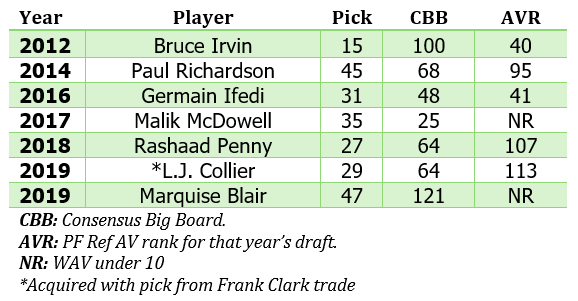
Schneider whiffed on the top pick after the trade down in all six drafts, plus a bonus miss on Collier in 2019. His average pick position after moving down has been 33rd, but he has picked players with an average consensus big board rating of 71 – that’s not good value, no matter what the GM tells you. None of those guys played up to their draft slots either, with Ifedi the only one coming close.
The four from 2017 to 2019 were complete busts who kept the Seahawks looking for players at their positions. McDowell’s wipeout partly led to the reach for Collier in the first round in 2019. Penny’s injuries – along with Carson’s – made Schneider so skittish about his RB room that he spent second-rounders in both 2022 and 2023 on running backs. Blair was overdrafted by two rounds and then proved it, leading Schneider to trade for Jamal Adams a year later.
The moral of this history? Trading down does not always bring all the good stuff you expect it to. And, if you are in the middle of the draft, you should strongly consider whether you want to drop into the 20s, where the hit rate is lower and the danger of reaching for a player (at least for Schneider) grows exponentially.
Meanwhile, the 16th overall pick has a success rate of 40% over the past decade, per Pro Football Reference (i.e., four guys rank at least as high as their draft spot in PF Ref’s AV scoring).
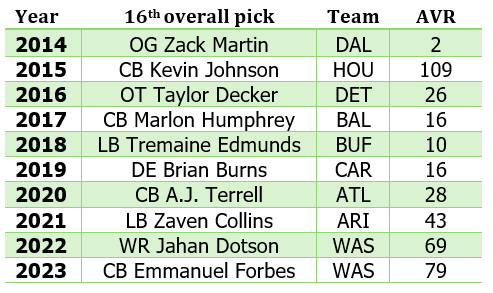
Many mock drafts have Schneider using the 16th pick on a lineman from either side of the ball. With a heavy need at guard, UW’s Troy Fautanu is a very popular mock. He could be the next Zack Martin, the 16th pick in 2014 who is ranked by PFR as the No. 2 player from that draft class.
On defense, Byron Murphy of Texas and Johnny Newton of Illinois both have their share of advocates. Penn State pass rusher Chop Robinson also visited VMAC, and UCLA pass rusher Laiatu Latu also is being linked to Seattle. Jared Verse, the edge rusher from Florida State who visited VMAC last week, is likely to be gone in the top 12.
Where is the shelf?
If Schneider really wants to add a pick, how far can he go to get it and still get a guy he really wants? That obviously depends on what the Hawks’ board looks like and how the draft falls.
The consensus big board compiled by The Athletic currently lists the above players in this order: Verse 10, Latu 14, Fautanu 17, Murphy 18, Newton 23, Robinson 25.
So the Hawks are sitting right on the shelf where they likely could get Latu, Fautanu or Murphy. Move down to the 20-25 range, and they appear to be looking at Newton, Robinson or maybe Duke guard Graham Barton (Lance Zierlein’s latest mock draft projects the Hawks to drop back to 23 and take Barton).
A drop all the way to 25 with the Packers likely would net pick No. 58 (with Seattle probably giving up pick No. 118 in return). But, as illustrated above, Schneider cannot be trusted to pick a valuable player in that range or make much out of other assets he acquires in such deals.
The best move probably will be to stay at 16 and take an impact player rather than force a move and end up possibly whiffing on both the picks acquired.
 CHAWK TALK: Everything being said about the Seahawks